




Male Revision Plastic Surgery: Corrective and Reconstructive Procedures for Men
Male revision plastic surgery is corrective surgery for men whose first cosmetic procedure didn’t turn out the way it should have. Usually the man knows exactly what’s wrong before he walks in. His chest has a dip under the nipple that wasn’t there before his gynecomastia surgery, or the lines from his ab etching sit an inch away from where his muscles actually are when he flexes in the mirror. Sometimes it’s his face: a jaw that used to have corners and now doesn’t, or a nose that got so much smaller it stopped matching the rest of him.
A lot of these cases go back to the same thing: Most cosmetic surgery techniques were developed on women, and when a surgeon uses them on a man without changing much, the man tends to come out looking rounder and smoother than he should, sometimes outright feminized. Dr. Douglas Steinbrech has spent his career operating on men specifically, and fixing a wide variety of botched surgeries. He’s a Board-certified Plastic Surgeon, he wrote the textbook Male Aesthetic Plastic Surgery (45 chapters on how operating on men differs from operating on women), and he has performed more than 3,000 revision procedures on men.

The Biomechanics of Male Corrective Surgery
Men’s skin is thicker than women’s, and in a revision that works against you more than it helps. Thick skin hides small ripples well, but it won’t shrink down to fit a new shape the way thinner skin sometimes will. If a liposuction cannula left a groove in the fat underneath, a man’s skin tends to bridge right over it and stay that way, and waiting a few months usually doesn’t change much.
Men also bleed more during facial surgery. The beard has a big blood supply running just under the skin, and surgeons have known for decades that men develop hematomas (blood pooling under the skin after surgery) after facelifts more often than women do. Go back into that face a second time and you’re cutting through scar that has grown its own fresh capillaries, which bleed easily, so the whole operation has to be planned around controlling it.
The fat is different, too. In the chest and flanks, male fat is tougher and more fibrous, threaded with thick bands of connective tissue. A cannula pushing through it tends to wander toward whatever spot gives way first, and that’s often how the uneven channels from a bad liposuction got there in the first place. Gynecomastia gland is denser still, a firm, rubbery disc behind the nipple that a cannula can slide right past without taking much.
Muscle also drives how a lean man looks. What people call a six pack is the rectus abdominis, broken into segments by bands of tendon and bordered on each side by a groove called the linea semilunaris. If an etching job ignores where those really are, it looks wrong as soon as he moves.
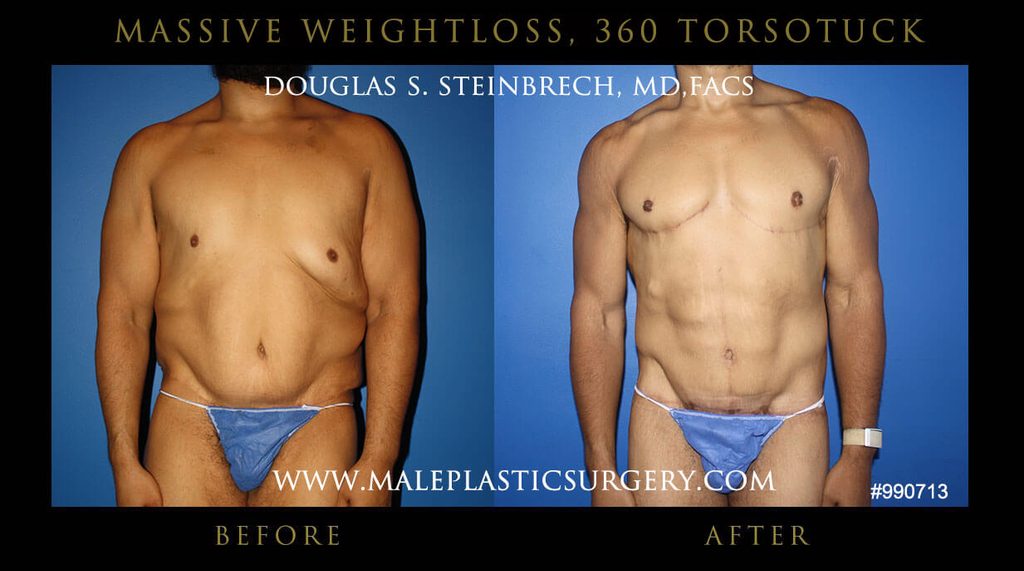
Identifying Suboptimal Outcomes
Most of the bad results we see fall into one of three groups.
Too Much Removed
Most men going into surgery worry the surgeon won’t take enough. What we see just as often is a surgeon who kept going. Run a cannula too close to the underside of the skin and you strip out the fat that was supposed to cushion it, so the skin heals down onto the muscle like wet paper on a tabletop. Ask him to tense his abs or his chest and the dent gets worse, because the skin is now riding on the muscle itself. Surgeons call that tethering. Faces get their own version. Pull too much fat from the temples or from under the cheekbones and a man in his forties can look ten years older, which is about the opposite of what he paid for.
Structural Failure
This group is about things that moved or hardened after surgery. Pec implants drift toward the armpit when the pocket was cut too wide. Scar forms a capsule around the implant and slowly squeezes it out of shape. Chin implants that were never screwed to the bone rotate. Unlike swelling, none of this gets better if you wait it out. Capsules keep tightening and pockets keep stretching, so it usually gets worse. This result can leave a patient feeling deformed or insecure with the way they look.
Feminization of the Male Form
The frustrating thing about a feminized result is that the surgery often did what it was supposed to, technically. The gland came out, the implant went in, the nose got smaller. It just doesn’t look like a man anymore. The corner of the jaw, the gonial angle, has been shaved or rounded away. The chin has been pushed back, or the bridge of the nose has a little ski slope scooped into it, or the brows have been lifted into an arch. Male faces look male mostly because of angles and straight lines, and techniques designed to give women curves take those away. Chests get it too. Flatten a man’s chest too aggressively and the lower edge of the pectoral muscle disappears, along with the shelf that makes it read as a man’s chest.
Core Revision Procedures We Perform
High Definition Liposuction and Abdominal Etching Revision
We revise more etching jobs than almost anything else, and the bad ones have a family resemblance. Somebody drew the lines on while the patient lay flat and relaxed, without having him crunch first to see where his tendon bands really fall. So the grooves end up too high, or ruler straight, or laid out in a tidy grid of six that his abdomen never had to begin with. (Plenty of men have eight segments. A few have only four, and a lot of them are a little lopsided.) Then he flexes in the mirror and there are two six packs, the drawn one and his real one about a centimeter lower. If the surgeon also cut too deep along the center line, the linea alba, the skin may have healed straight down onto the rectus sheath and left a stiff trench that doesn’t move with the rest of him. Uneven passes with the cannula can add a lumpy, cobblestoned surface on top of all that.
The repair starts by freeing the skin. Using a technique called subcision, Dr. Steinbrech cuts the scar bands holding the skin down to the muscle sheath so it can lift back up. Then the low spots get filled with the patient’s own fat. His BodyBanking® approach treats harvested fat almost like building material, placed in small amounts to rebuild the smooth slope from the rectus out to the obliques. Before any new definition is added, he marks the patient’s real tendon bands and the linea semilunaris while the patient flexes, so the lines follow actual muscle this time. Not every graft takes. Fat needs a blood supply to live in its new spot, and scarred tissue doesn’t offer much, so with a deep trench we tell patients up front they may be back for a second, smaller round of grafting.
Gynecomastia and Male Chest Revision (Crater Deformities and Residual Tissue)
Gynecomastia revisions come in two kinds that couldn’t be more different. One man has too much left. The other has too little.
The too much case usually goes like this. A guy had lipo on his chest, it looked great at two weeks, and then as the swelling went down the puffiness came right back. The cannula pulled out the fat and left the gland, a firm disc under the nipple that liposuction is bad at removing. Honestly, this is the good news version of a failed gyno surgery. Dr. Steinbrech goes in through a small incision along the lower edge of the areola, cuts the gland out directly, and trims the edges until the area under the nipple feels about as thick as the chest around it.
In the second, too much came out. Careful surgeons leave a small disc of tissue under the nipple, often around a centimeter thick, because without it the nipple has nothing to sit on. Take everything down to the fascia covering the pectoral muscle and the areola sinks into the hole and scars onto the muscle. Surgeons call that a crater or saucer deformity, and it’s a much harder repair. First the scar holding the areola down has to be released. Then the hollow gets filled, either by moving a flap of nearby fat into the gap or by injecting tiny droplets of fat across the pectoralis major until the chest is level again. Any gland left around the edges comes out at the same time.
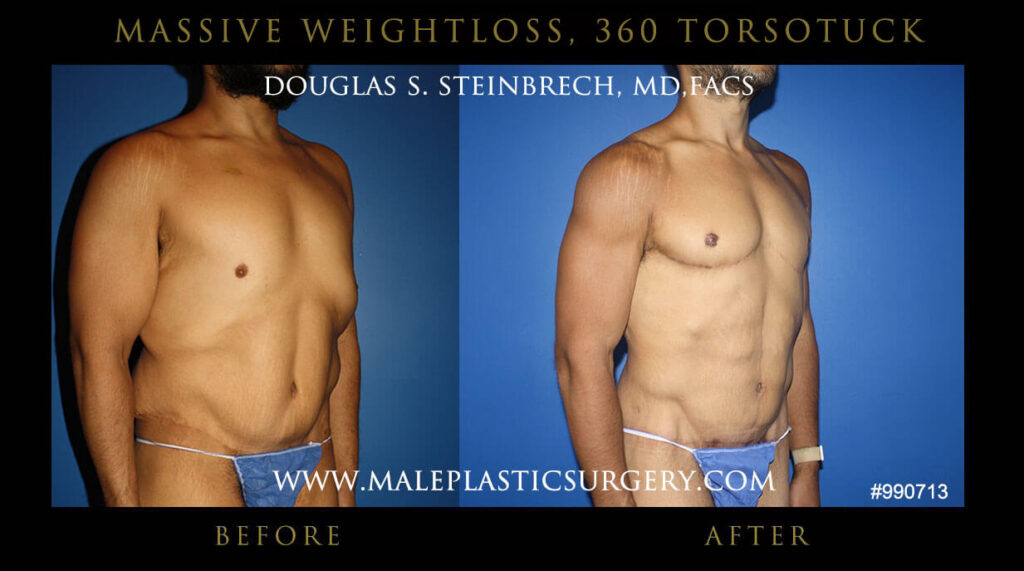
Pectoral Implant Revision and Asymmetry Correction
Pec implants are solid silicone, so they can’t leak or rupture the way breast implants can. When they fail, it’s almost always about position. Where it goes wrong depends on how the pocket was made. Cut it too wide toward the side and the implant wanders into the armpit, which men usually notice first when they raise an arm. Cut it too high and the implant rides up near the collarbone, its upper edge showing as a ridge under thin skin. Some implants spin a few degrees inside the pocket, so the shape fights the direction of the muscle fibers instead of following them. The other failure is capsular contracture. Every implant gets wrapped in a capsule of scar tissue, and in some men that capsule thickens over months until the implant feels like a hockey puck and starts to look misshapen.
What Dr. Steinbrech does depends on what he finds. A tight capsule can be scored to release it (a capsulotomy) or removed completely (a capsulectomy). A pocket that has stretched can be stitched smaller so the implant stays put, which surgeons call a capsulorrhaphy. If the implant was simply the wrong size, it can be swapped for a custom one placed under the pectoralis major. And for some men the better call is to take the implants out and build the chest with fat transfer over the muscle. You give up some projection, but there’s nothing left that can move or harden.
Male Facial Revision: Jawline, Chin, and Feminization Reversals
Most facial revisions in men come down to the shape of the bone and the direction the skin was pulled.
A chin or jaw implant that was just tucked into a pocket, never screwed to the bone, has room to move, and over a year or two a lot of them do, sliding to one side or tilting. Stock implants have another problem. They come in a handful of sizes built for an average jaw, and laid on a jaw that isn’t average they leave a step you can feel and sometimes see. For revisions, Dr. Steinbrech can use custom implants designed from a CT scan of the patient’s own mandible. They sit flush against the bone because they were shaped from it, and screws keep them there.
Most of the failed male facelifts we see were pulled in the wrong direction. A surgeon trained mostly on women tends to pull the skin back toward the ear, and on a man that produces the windswept look, like he’s standing on the deck of a boat in bad weather. Men’s faces don’t age that way. The tissue drops more or less straight down, so the lift has to go more or less straight up, and that work happens in the SMAS (the layer of muscle and connective tissue under the skin) rather than by tugging on the skin itself. In a revision, the SMAS first has to be freed from the scar the old lift left behind before it can be reset.
Women don’t have this next problem, which may be why so many surgeons forget about it. A facelift incision often runs up near the temple, and if it’s placed without thinking about the sideburn, the lift drags hair bearing skin backward and up. The sideburn shrinks or disappears. Some men find they now have to shave behind their ears. Repairing it starts with keeping any new incisions along the hairline he has, and where there’s enough slack, moving the hair bearing skin back down to roughly where it used to grow.

Revision Male Eyelid Surgery (Blepharoplasty)
Take out too much fat during upper eyelid surgery and the area between the brow and the crease caves in. Startled is the word we hear most. A lot of these men went in because they looked tired and came out looking like someone had just jumped out at them from behind a door. The fix is putting the volume back with tiny fat grafts placed into the hollow.
The lower lid can go wrong in a way that’s more than cosmetic. If too much skin was taken, or scar forms in the middle layer of the lid, the edge of the lid gets pulled down off the eye. Surgeons call it ectropion, and in photos it shows up as a strip of white under the iris. It also dries the eye out, so men with it usually complain about burning and watering before they complain about how it looks. Support comes back through the tendon at the outer corner of the eye. In a canthopexy it gets tightened with sutures. In a canthoplasty it’s detached and reattached, which holds better when the lid is very loose. A badly retracted lid sometimes needs a small graft to make it longer.
Secondary Male Rhinoplasty (Structural and Masculine Restoration)
The typical male nose revision is a nose that got made too small. Maybe the bridge was taken down so far it now has a scoop in profile, or the tip looks pinched from the front. Often there’s a breathing complaint too, because the cartilage holding the sides of the nose open lost its support and now caves in a little on every breath. You can’t fix that by taking more away. It has to be rebuilt with cartilage grafts. Spreader grafts along the septum open the airway back up, and grafts along the bridge straighten it out again. Because the first surgeon often used up most of the septum, rib cartilage gets used in revisions more than patients expect.
Timing Your Revision: The Biology of Scar Maturation
Almost every revision patient wants the fix done as soon as possible, and almost every one of them gets told to wait. Dr. Steinbrech asks most men to hold off 6 to 12 months after their last surgery, and up to 18 months for complicated nose revisions or heavy liposuction repairs.
The reason has to do with how scar heals. In the first months after surgery, the body fills the wound with a fast, disorganized kind of collagen (type III) and grows lots of new blood vessels into it. That young scar is stiff, bleeds when it’s cut, and is still shrinking. Over the next several months, stronger and more organized type I collagen takes its place, the extra blood vessels die back, and the tissue loosens up. The swelling finally goes down as well, so the surgeon can see what the first operation really left behind. Operate before all that happens and you get more bleeding, plus a fresh scar that may contract even harder than the old one did.
Here’s roughly how long to wait, by area:
- Gynecomastia and chest contour: 6 to 12 months
- Pectoral implants: 6 to 12 months
- Jaw and chin implants: 6 to 12 months
- Facelift and neck: 6 to 12 months
- Eyelids: 6 to 12 months
- Liposuction and abdominal etching: 9 to 12 months, up to 18 for extensive cases
- Rhinoplasty: 12 to 18 months
There are exceptions. An infection or an implant pushing through the skin needs to be seen right away, and so does a lower eyelid pulled down far enough to leave the eye exposed.
Our Approach: Reconstructive Diagnostics and Surgical Strategy
Planning a revision starts with whatever records exist from the first surgery. Operative notes show which implants or grafts were used and which layers were opened. Photos from before the original procedure show what the patient looked like going in, which is often the best guide to what he should look like again. Dr. Steinbrech also uses high resolution 3D imaging to map the area as it is now and measure how far one side differs from the other.
The exam tells him more than any of that. He pinches the skin to judge how thick it is, has the patient tighten the muscle underneath to see where scar is tethering, and checks where fat could be harvested if grafting is needed. Scar that turns white when pressed and feels stiff hasn’t finished maturing. A thin patch stuck down over a dent may not have enough blood supply to support a big graft all at once.
He also knows most of these men aren’t walking in relaxed. Plenty of them are angry at the first surgeon, some are embarrassed to be back, and a lot of them don’t believe anything a surgeon promises anymore, which is fair. So the consultation sticks to what he can see and measure: what went wrong and what the remaining tissue can realistically handle. Some men leave with a surgery date and some are told to wait. Once in a while he tells a patient that another operation wouldn’t make things better, and he’d rather say that than sell a surgery that won’t help.

Surgical Realities: Balancing Perfection with Anatomical Preservation
Nobody can promise a perfect revision, and a surgeon who does should make you nervous. A second operation starts with less to work with than the first one did. The original surgery damaged some of the small blood vessels in the area and replaced loose tissue layers with scar, and if too much was removed, that tissue isn’t coming back.
All of that limits what grafts can do. Fat grafts survive by picking up blood supply from the tissue around them, and scarred tissue doesn’t supply much, so some of the fat gets reabsorbed. Some patients need the work done in stages over more than one surgery.
Revision can still do a lot of structural correction. Tethered skin can be released and lost volume rebuilt, and implants can be moved, replaced, or taken out, which usually brings the two sides much closer to even. What it usually can’t do is make the area look like no one ever operated on it.
The risks run higher than with a first surgery, too. Scar bleeds more and healing takes longer, and new irregularities or scars sometimes need their own treatment later. Dr. Steinbrech goes through all of it in the consultation before anything gets scheduled.
Frequently Asked Questions
Why do so many male plastic surgeries need revision?
Because a lot of surgeons use techniques built for women on men. Men have thicker skin and tougher, more fibrous fat, their jaw and brow bones are shaped differently, and the beard limits where facial incisions can go. Pull a man’s face the way you’d pull a woman’s, or take tissue the way you would from a woman’s chest, and his features get rounded off.
How do you fix divots or uneven grooves from bad liposuction?
Usually in two steps. Subcision cuts the scar bands holding the skin down against the muscle, and then fat grafting using BodyBanking® principles fills the low spots and rebuilds a smooth transition between muscle groups.
Can a crater from gynecomastia surgery be fixed?
Yes. A crater happens when the tissue under the nipple was removed all the way down to the muscle. The repair releases the scar holding the areola down and then fills the hollow, either with a flap of nearby fat or with grafted fat.
Do I need the operative notes from my previous surgeon?
They help, especially for knowing what implants or grafts were used and which layers were opened. But Dr. Steinbrech regularly evaluates and operates on revision cases where the records are incomplete or missing entirely.
How does recovery compare to the first surgery?
Swelling and settling generally take 20 to 30 percent longer, because of the existing scar and the more involved dissection. Time off work still usually falls between 7 and 14 days, depending on the procedure.
How long should I wait before getting a revision?
Usually 6 to 12 months, which gives the scar time to mature. Complex nose and liposuction revisions may need up to 18 months.
Can I get a revision if I live in another state?
Yes. You can start with a virtual review by sending photos through our secure form, then decide whether to travel for an in person consultation.
Consult with Dr. Steinbrech on Your Corrective Options
Dr. Steinbrech handles every revision consultation himself, at our offices in New York, Los Angeles, and Chicago. If you live somewhere else, send photos through our secure form for a virtual review, and he’ll look at what was done and tell you whether a trip makes sense. Bring your operative notes if you have them. If you don’t, reach out anyway.
 Douglas S. Steinbrech, M.D., F.A.C.S. is a plastic and reconstructive surgeon that specializes in male aesthetics. Dr. Steinbrech is certified by the American Society of Plastic and Reconstructive Surgeons and a diplomate of the American Board of Plastic Surgery.

