




The Male Facelift
Aging doesn’t happen all at once. It’s gradual. A little more looseness under the chin. The jaw starts to blur. The folds around the mouth go from subtle to impossible to ignore. Men tend to live with it longer than they should, and then one day something tips the scale. A photo. A video call. Just the bathroom mirror on the wrong morning. That’s usually the moment men call us.
Dr. Douglas Steinbrech has spent his career operating on male patients—only male patients—at his practices in New York City, Los Angeles, and Chicago. A facelift performed on a man isn’t the same as one performed on a woman. The anatomy is different. The skin is thicker. The hair patterns around the ears and temples change where incisions can be placed. The goals are different too. Men aren’t after a dramatic overhaul. They want to look the way they looked a decade ago, and they don’t want anyone to be able to tell they did anything.
When it’s done right, nobody can.
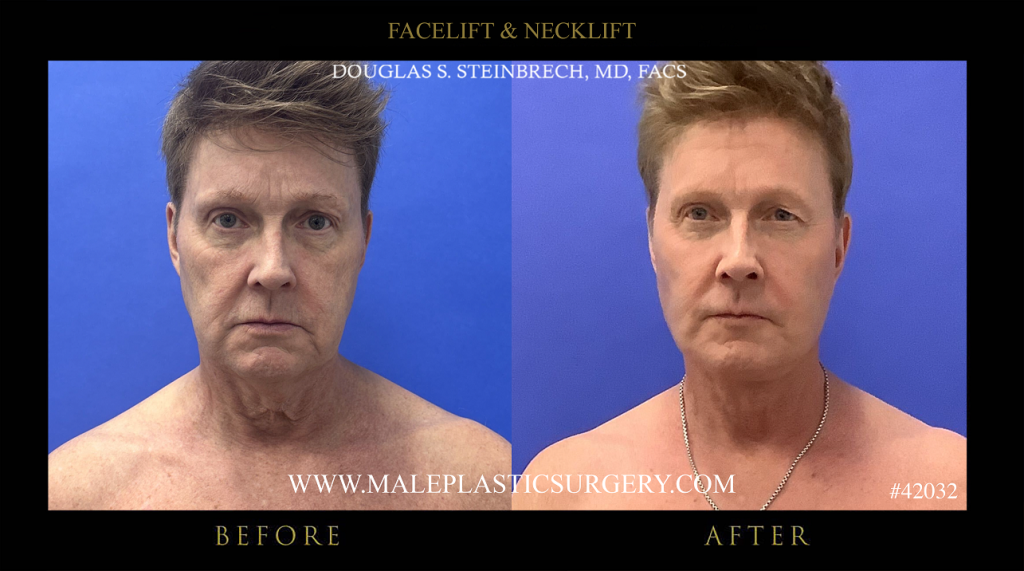
What Is a Facelift?
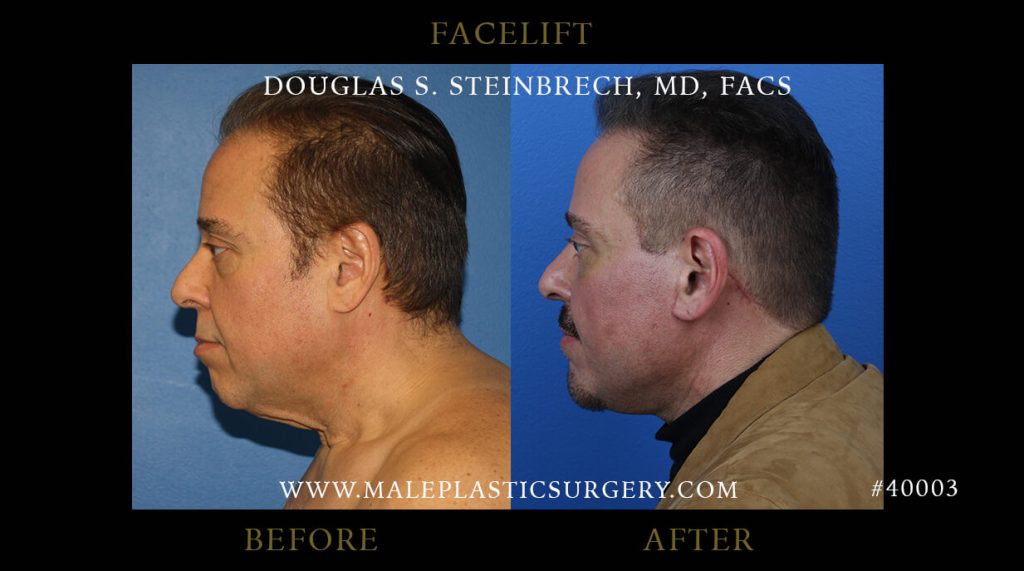
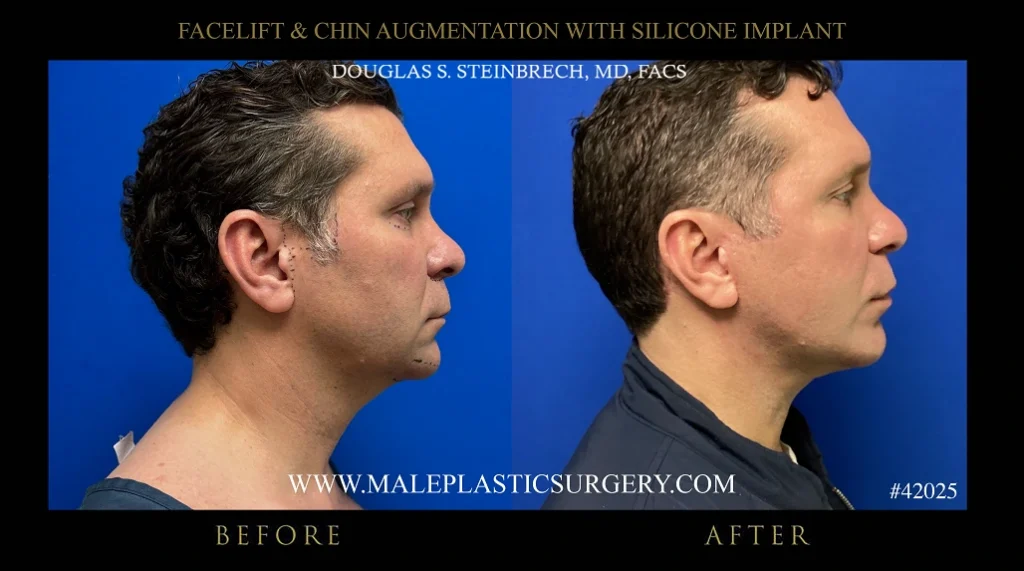
Rhytidectomy is the clinical name. What it goes after is the stuff that actually makes a face age—not the surface, but underneath it; tissue that used to hold things in place loosens up over the years. Fat moves around, filling in the neck and jaw where it never used to be. Muscle tone changes. The skin gets dragged along with all of it, and the result is a face that reads heavier and older than it should. That’s not a moisturizer problem. Fillers buy time—sometimes years—, but they don’t rebuild permanent structure. When the structure has shifted enough, surgery is the only way to fix it at the source.
At Male Plastic Surgery, Dr. Steinbrech works below the skin’s surface. Tissue and muscle get repositioned. Fat is either removed or moved depending on what the face needs. Then the skin that’s now excess—the stuff that was being pulled down by everything shifting underneath—gets trimmed away. The skin isn’t stretched tight. The framework underneath it is corrected first. That’s what separates a result that looks like the patient had a great night’s sleep from one that looks like something was pulled.
Types of Facelift Procedures
Not every facelift is the same procedure. The right approach depends on what’s happening with the face and how much correction is needed.
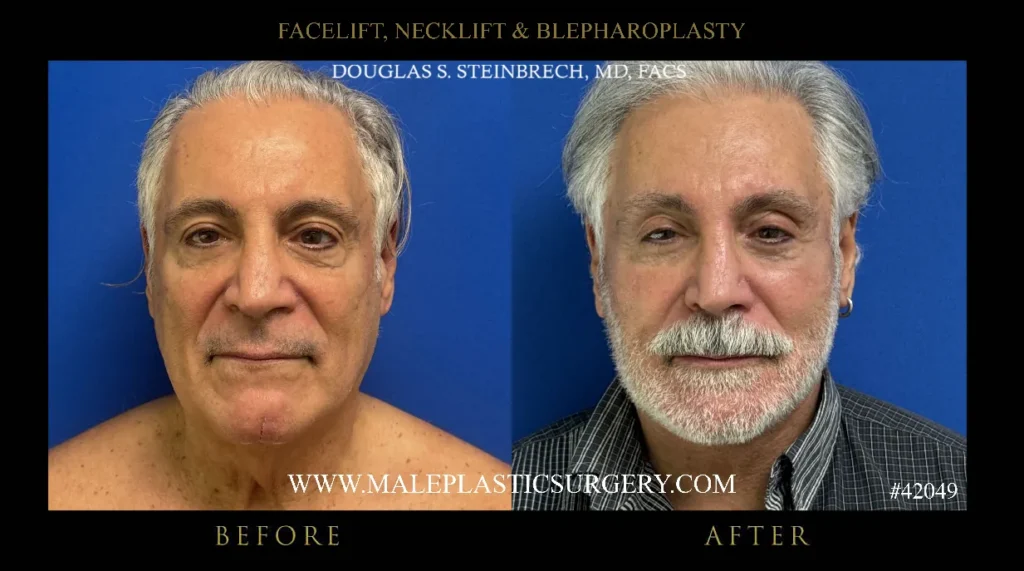
Traditional Facelift
This is the gold standard and has been for decades. Incisions begin at the temple, run down in front of and around the ear, and end at the lower scalp. In cases where the neck needs significant work, a small additional incision is made under the chin. The access this approach provides allows Dr. Steinbrech to work more thoroughly—deeper tissue repositioning, more significant muscle work, more complete fat management. The results are more dramatic and they last longer. Recovery takes more out of a patient than the limited approach, but for men with advanced signs of aging, it’s usually the right call.
Limited Incision Facelift
Smaller cuts, faster return to normal. Incisions go at the temple, near the ear, under the lower eyelid, beneath the upper lip. Local anesthesia only—patients stay awake the whole time. Most men are back to their regular schedule within a few days, not a few weeks. Men who are catching things earlier, or who have one or two specific areas bothering them more than the whole face, tend to find this fits what they’re after. Less correction overall than the traditional approach, and the results don’t hold quite as long—but the recovery is a fraction of the time.
Dr. Steinbrech will be direct with you during the consultation about which approach makes sense for your face. There’s no one-size answer.
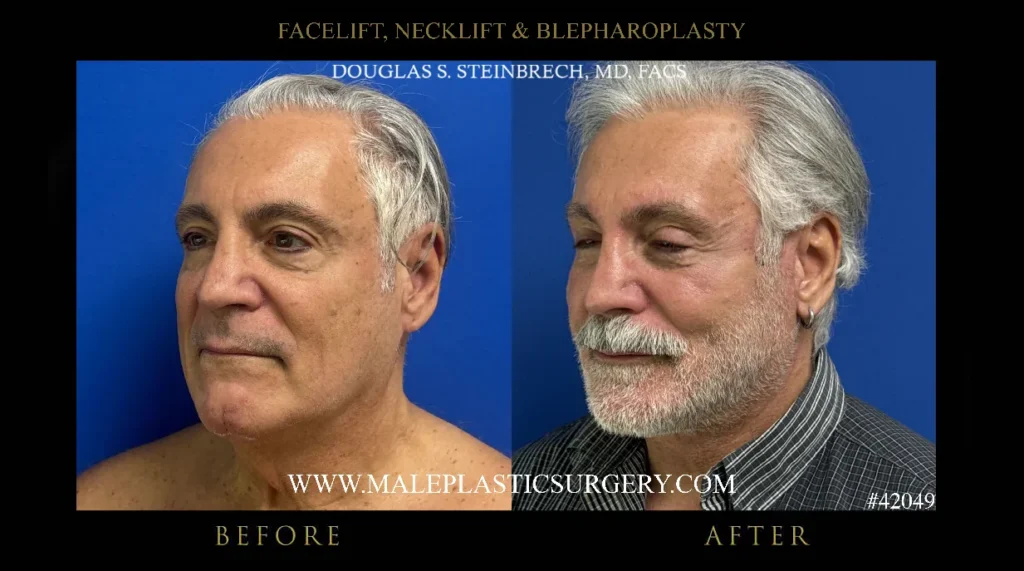
Are You a Good Candidate?
The majority of men who pursue facelifts are somewhere in their 40s, 50s, or 60s—though age isn’t the determining factor. Health is. Men in good general health who don’t smoke, or who are prepared to stop smoking well in advance of surgery, tend to heal cleanly and see the best outcomes. Any medical condition that affects circulation or wound healing gets evaluated carefully during the consultation.
What actually brings most men through the door is a specific set of things they’re noticing. Jowling along the jaw that’s softening the definition they used to have. Heaviness in the neck that exercise doesn’t touch. Folds getting deeper around the nose and mouth. A general droopiness through the middle of the face that showed up somewhere in the last few years. When those things start stacking up and affecting how a man moves through the world—how he feels in a meeting, in a photo, across the table from someone—that’s when it’s worth having the conversation.
Dr. Steinbrech looks at the face in front of him, not a demographic profile. He’ll tell you directly what surgery can fix and what it won’t.
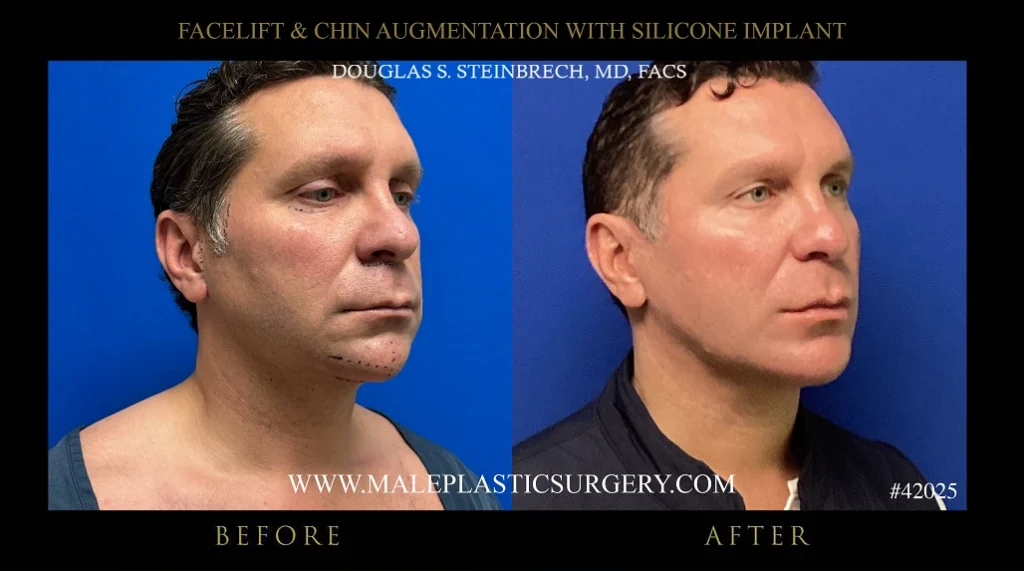
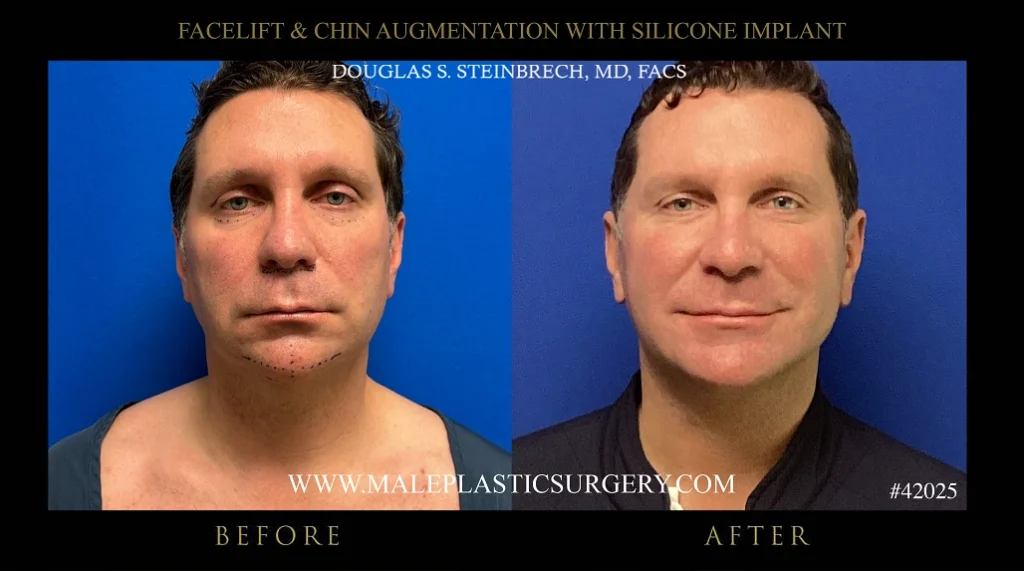
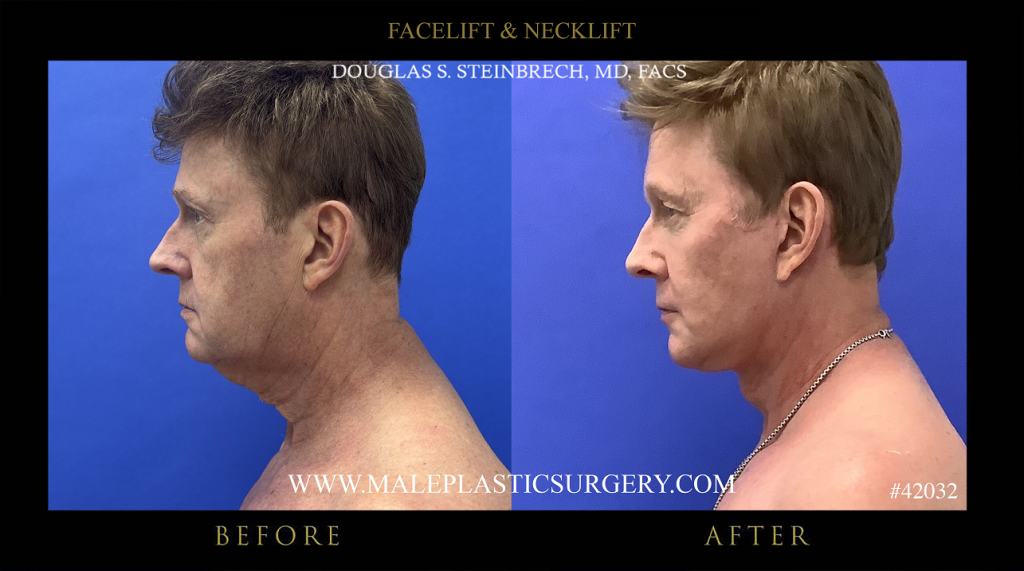
Male Facelift Before and After Photos
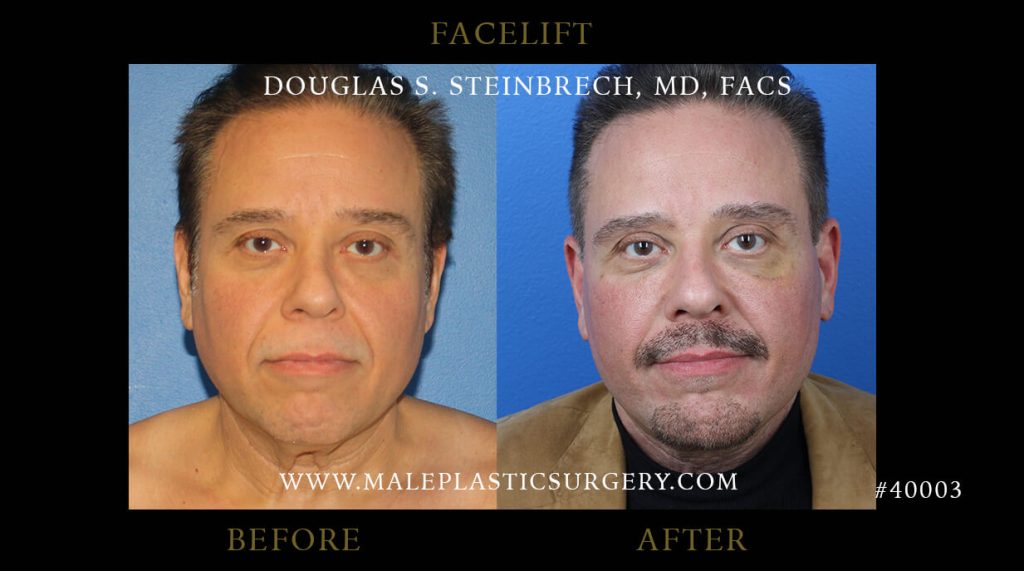
View Full Men’s Facelift Gallery
What to Expect During Recovery
Plan on going home the day of surgery, maybe the next morning. For the first couple of days, small drainage tubes sit near the incision sites—they come out at the first follow-up appointment, usually before the 48-hour mark. Week one is when you feel it most. Swelling and bruising peak early, which is also when the pain medication does its job. Most men are on prescription medication for the first few days, then switch to over-the-counter by the end of the week. By day seven, most patients are moving around, getting out, handling the basics—just not back at a desk or operating at full capacity yet.
Week two is when things start to open up. The swelling comes down noticeably. Results start becoming visible. By the end of week three, most men have crossed into full recovery territory, with only residual bruising and minor swelling remaining. Any facial numbness in the treated areas is completely normal—it resolves gradually over the months following surgery.
The exact timeline varies depending on which procedure was performed, the patient’s age, and overall health. Dr. Steinbrech’s team provides a detailed, personalized recovery protocol before the patient leaves.
Frequently Asked Questions: Men’s Facelift
Is it going to be obvious I had something done? That depends entirely on who does it and how. Over-tightened facelifts that distort the face or pull the hairline are the result of poor technique and poor planning. The goal with every male facelift Dr. Steinbrech performs is that the patient looks like a well-rested, sharper version of himself—not a different person. The men who’ve had this procedure here routinely hear from people that they look great. Nobody asks what they had done.
How long will results last? Most men see results that hold up for seven to ten years, sometimes longer. What accelerates aging after a facelift is the same thing that accelerated it before—smoking, sun exposure, significant weight fluctuation. Men who take care of themselves after surgery tend to get more out of the result. The procedure resets the starting point. It doesn’t freeze it permanently.
Which procedure is right for me—traditional or limited incision? There’s no universal answer to that question. If the changes to your face are significant, if the jowling is pronounced or the neck has substantial excess, traditional is usually the right move. If you’re catching things earlier and you’re more concerned about the recovery commitment than the degree of correction, limited incision is worth exploring. The consultation is where that decision gets made—with Dr. Steinbrech looking at your specific face, not a general profile.
What does the first week actually feel like? Uncomfortable, but manageable. Prescription pain medication covers the first few days for most patients. Swelling is significant early on and starts improving noticeably after day four or five. Bruising follows a similar pattern. Most men describe the experience as worse in anticipation than in reality—the discomfort is real, but it’s controlled, and it’s short.
Can I combine a facelift with other procedures at the same time? Yes, and many men do. Neck lift is a natural pairing—the two procedures complement each other anatomically. Eyelid surgery is another common combination. Nonsurgical treatments like the MaleModelMakeover® are sometimes added to address facial volume and structure alongside the lift. What makes sense to combine gets worked out during the consultation based on what you’re actually trying to accomplish.
What does the consultation involve and what does it cost? The consultation is a sit-down with Dr. Steinbrech—not a coordinator, not a PA. He’ll look at your face, ask about your goals, explain what surgery can realistically achieve, and give you a direct recommendation. The fee is $400, which is applied toward the cost of your procedure if you move forward.
Schedule a Consultation
Men’s facelift consultations are available at all three locations—New York City, Los Angeles, and Chicago. The $400 consult fee is credited toward your procedure.
 Douglas S. Steinbrech, M.D., F.A.C.S. is a plastic and reconstructive surgeon that specializes in male aesthetics. Dr. Steinbrech is certified by the American Society of Plastic and Reconstructive Surgeons and a diplomate of the American Board of Plastic Surgery.
